Why pay for four AI subscriptions? Multi-model apps explained
If you regularly use more than one AI model, a multi-model app replaces several subscriptions with one and lets you change models inside a conversation. What you trade away is immediacy on each provider's newest product features. If you live in exactly one assistant and want its experimental modes the week they ship, subscribe to that provider directly — that's the honest version, from people who build one of these apps.
The arithmetic, stated plainly
Consumer plans for the major assistants cluster in the same price band — roughly $20 a month each, as of August 2026. Two of them costs more than most people's streaming budget; four is a line item you'd notice. Aggregator apps exist because that maths is uncomfortable and because most people's actual usage is spread across models rather than concentrated in one.
We build GO AI Chat, which is one of these apps, so treat the framing as interested — and judge the trade-offs below on whether they're the real ones, not on who's listing them.
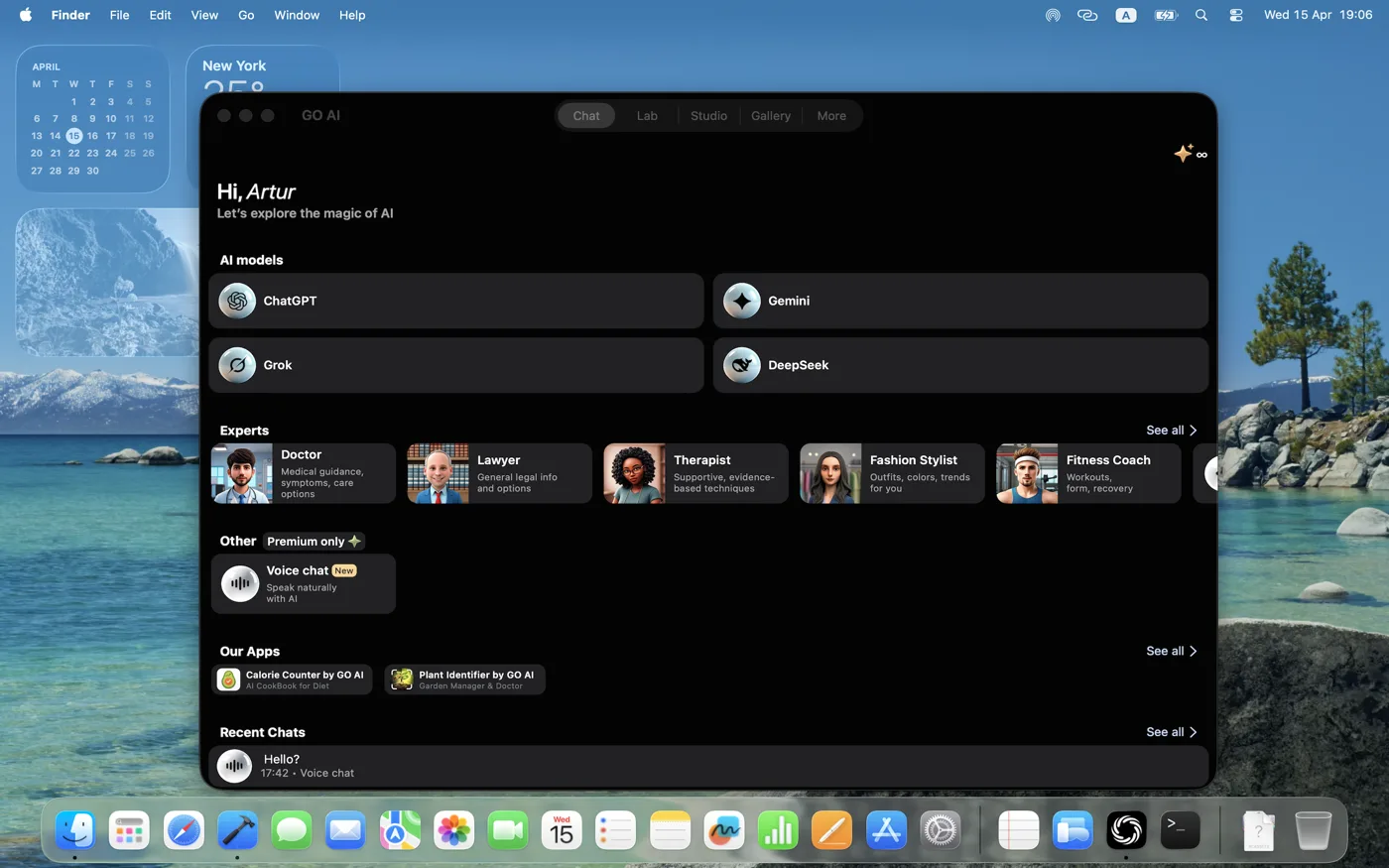
What you actually gain
- Switching mid-thread. This is the real feature, and it's the one you can't replicate with four separate apps. Draft with GPT-5, hand the same conversation to Gemini for a long document, ask Grok what happened this morning — without re-pasting context into a new window.
- One bill, one login, one history. Your conversations live in one searchable place instead of four.
- Cheap comparison. Asking two models the same question and reading the disagreement is a genuinely good habit, and it's frictionless when they're side by side. The disagreement is where the useful information usually is.
- Extras the providers don't bundle together. In our case: image generation across three model families, video via Grok, voice mode, and a photo editor in the same subscription.
What you actually give up
The honest list, because the version without it isn't worth reading:
- Feature lag. Aggregators reach models through provider APIs. The models themselves arrive quickly; the surrounding product features don't always arrive at all. A provider's newest experimental mode may be app-only.
- A middle layer. Your prompts pass through one more party. That's a real privacy consideration, and the correct response is to read the app's policy rather than assume either the best or the worst.
- Deep ecosystem integration. If a provider's assistant is wired into tools you already live in, a third-party app won't reproduce that.
- Usage shape. Aggregators typically meter heavy generation (images, video) rather than offering flat unlimited use. If you generate media all day, price that out before switching.
Who should subscribe direct
| You are… | Better fit | Why |
|---|---|---|
| Using one model for nearly everything | That provider, direct | You'd pay for breadth you don't use |
| Dependent on a provider's newest experimental features | That provider, direct | API surfaces lag app surfaces |
| Deep in one company's ecosystem | That provider, direct | Integration is the product |
| Using two or more models weekly | Multi-model app | Cost and mid-thread switching both compound |
| Also generating images or video | Multi-model app | Usually bundled rather than a separate subscription |
| Not sure which model you prefer | Multi-model app | Comparing is how you find out |
The question worth asking instead
"Which app has the most models" is the wrong axis; every aggregator can add another API. The better questions are whether switching preserves your conversation, whether the app is honest about what's metered, and whether the extras are ones you'd otherwise pay for separately.
If you're still deciding between specific models, our task-by-task guides are more useful than any price table: which model for which task, GPT-5 vs Gemini, and Grok 4 vs GPT-5.
FAQ
Are multi-model AI apps worth it?
If you use more than one model regularly, yes — one subscription and mid-conversation switching. If you live in exactly one model and want its newest features immediately, go direct.
Do multi-model apps get the latest models?
Models arrive via provider APIs, usually close behind. What lags is surrounding product features, some of which are never exposed through an API.
Is my data treated differently?
It reaches the same providers, plus the app in the middle. Read that app's privacy policy — ours is at goaichat.app/privacy.
Can I switch models mid-conversation?
In GO AI Chat, yes — that's the core reason the format exists.