Turn any YouTube cooking video into a recipe
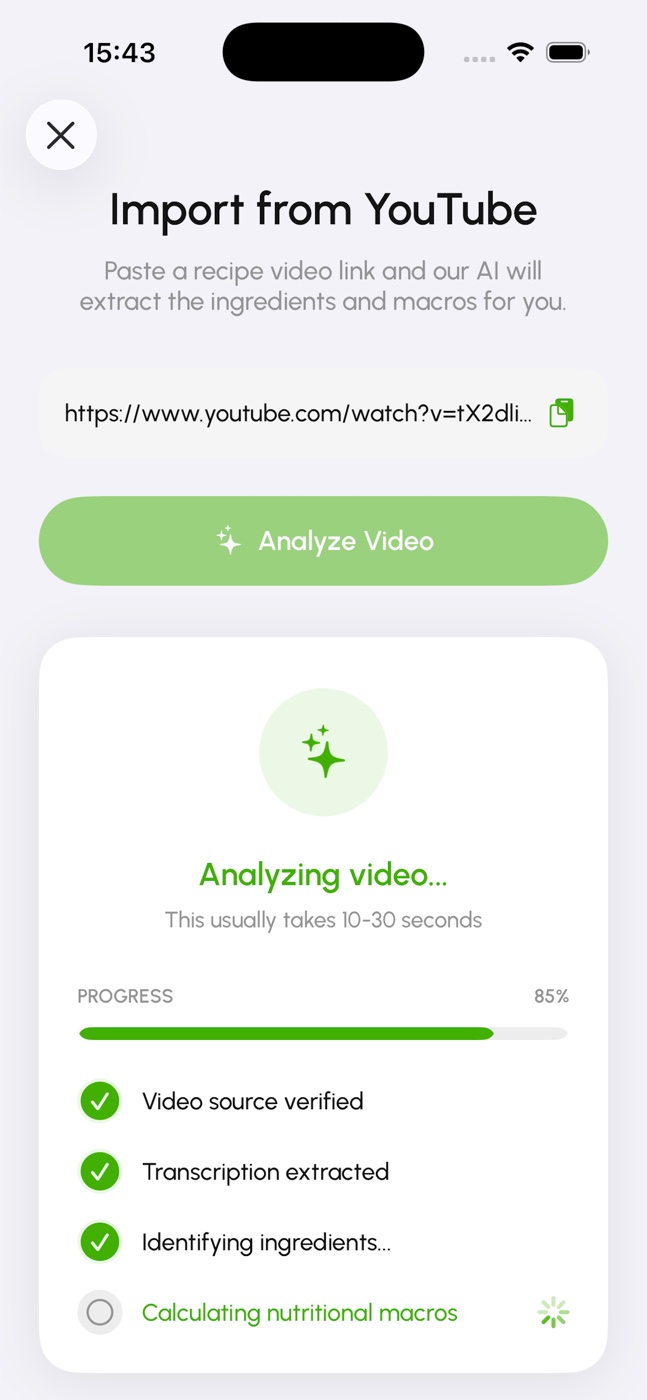
Cooking videos are wonderful to watch and hostile to cook from — you can't scan them, you can't check whether you missed an ingredient, and pausing with wet hands is its own punishment. Pasting the link into GO AI Calorie extracts the ingredients, the method as ordered steps, and an estimated nutrition breakdown you can scale. The limitation to know: quantities that are shown but never said are where the errors live.
Why the video format fights you
- No random access. "How much soy sauce again?" means scrubbing.
- No checklist. You find out you're missing an ingredient at the moment you need it.
- No arithmetic. The video serves four; you're cooking for two.
- No nutrition. Almost never stated, and rarely calculable from watching.
None of that is a criticism of the videos. It's just that "watch someone cook" and "cook this tonight" are different jobs, and one format is being asked to do both.
What extraction actually gives you
- An ingredient list you can check against your cupboard before you start — and turn into a shopping list for what's missing.
- Numbered steps you can glance at, with the order preserved.
- Estimated nutrition per serving, which the video almost certainly never mentioned.
- Scaling — change the servings and both the quantities and the nutrition move together.
Where it gets things wrong
| Problem | Why | What to do |
|---|---|---|
| Quantities shown, never said | On-screen text and visual estimation are weaker signals than speech | Check the ingredient list against the video description, which often has amounts |
| Cooking fat | "A drizzle" is not a measurement, and it is a large share of the calories | Set it yourself. This is the single biggest correction worth making. |
| Silent montages | Nothing is said, so there is little to extract | These convert badly. Pick a talking cook. |
| Improvised amounts | "Season to taste" carries no number | Fine — those ingredients rarely move the nutrition much |
| Serving count | Often unstated or optimistic | Set the servings you actually got, then let it rescale |
The pattern is the same one that shows up in indexing videos generally: transcripts capture what was said, not what was shown. A cook who narrates converts almost perfectly; a wordless aesthetic montage doesn't.
The workflow that's actually worth it
- Paste the link, extract the recipe.
- Fix the oil. Set the real amount you'll use.
- Set the servings to what you'll actually get from it.
- Check the ingredient list against what you have; send the gaps to a shopping list.
- Cook from the steps rather than the video.
- If you liked it, rate it and save it to the cookbook. That's the part that compounds — a personal cookbook of things you've actually made beats an infinite feed of things you might.
FAQ
Can AI turn a cooking video into a recipe?
Yes — paste the link and get an ingredient list, ordered steps, and estimated nutrition. Best on videos where the cook says what they're doing.
How accurate is the nutrition estimate?
An estimate built on estimates. Quantities shown but never said are the main error source, along with cooking fat. A starting point to correct, not a label.
Which videos work worst?
Silent or music-only montages, and heavy improvisation with no stated amounts. A talking cook converts almost perfectly.
Can I scale it afterwards?
Yes — and scaling should move the nutrition with the ingredients, which is the point of having it in structured form.