A song sung in your own voice
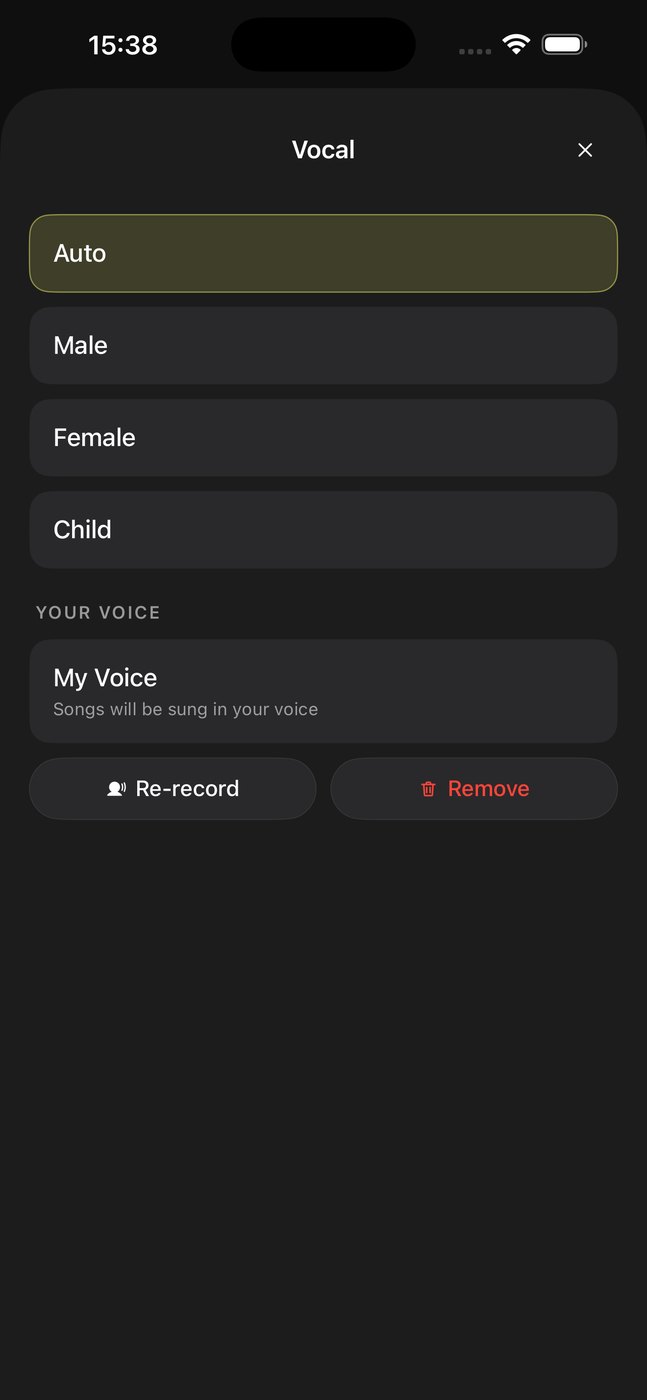
Record a short voice sample once in Musy AI, and it becomes a vocal option for every song you generate afterwards. You don't need to be able to sing — the sample captures the character of your voice, not your pitch control. It's the difference between "look what an app made" and "I made you this," which is a bigger difference than it sounds. This is scoped to your own voice only, deliberately.
What it changes
A generated song with a generic vocal is impressive for about ninety seconds. A generated song in a voice the listener recognises is a different object entirely — it stops being a demo of a technology and becomes something from a person.
The use cases where this matters are obvious once you've heard it: a birthday song that's actually you singing it, a message to someone far away, a joke that only lands because it's your voice delivering it. Everything else about the song can be automated; the voice is the part that can't be, and that's precisely why it carries the weight.
Getting a clean sample
The recording quality does most of the work here, and the fixes are unglamorous:
- Choose the room, not the technique. A room with soft furnishings — a bedroom, a sofa, curtains — beats a kitchen or a bathroom by a wide margin. Hard surfaces create reflections that end up baked into everything.
- Roughly a hand's width from your mouth. Closer gets breath and plosives; further picks up the room.
- Normal volume, natural register. Don't perform, don't project, don't put on a voice. You want the voice people know.
- Silence everything else. Television, music, a washing machine, a road. Background noise is the most common reason a sample disappoints.
- Do it twice. The second take is almost always more relaxed, and relaxed is what you want.
You don't need to be able to sing
This is the misconception that stops people trying. The sample is capturing timbre, accent, and register — the things that make your voice identifiably yours. Pitch accuracy isn't part of it. Speaking clearly is enough.
In practice, people who insist they can't sing are the ones most delighted by the result, precisely because they've never heard their own voice carry a tune before.
Pairing it with the right song
| Use | What works |
|---|---|
| A gift for someone | Warm, acoustic, 60 seconds. Your voice carries it; the arrangement shouldn't compete. |
| A joke | Commit to an absurdly serious genre. Your voice delivering a power ballad about the bins is the entire gag. |
| A message to someone far away | Sparse and slow. Fewer instruments means more of you. |
| Something for a video | Consider instrumental instead — a recognisable voice pulls focus from footage. |
The general rule: the busier the arrangement, the less your voice reads as yours. When the voice is the point, keep everything else out of its way.
Why only your own voice
We don't build cloning of other people's voices, and this is a deliberate product decision rather than a technical limitation. A voice is closely tied to identity, and generating speech or song in someone's voice without their knowledge is a category of harm that ranges from tasteless to fraudulent.
Scoping the feature to a voice recorded in the app, by the person using it, keeps consent structural rather than a checkbox. We'd encourage the same scepticism toward any tool that offers to do this casually with a voice you uploaded — the question worth asking is whose voice it is, and whether they agreed.
For everything else about writing the song, see song prompts that work.
FAQ
How do I make an AI song with my own voice?
Record a short sample once in the app; it becomes a vocal option for songs you generate afterwards. No re-recording per song.
How do I record a good sample?
Soft-furnished room, phone a hand's width away, normal volume and natural register, everything else silenced. Choosing the room matters more than technique.
Can I make a song in someone else's voice?
Not in Musy AI. The feature is limited to a voice recorded in the app by the person using it — cloning other people's voices raises consent problems we don't want to be part of.
Do I need to be able to sing?
No. The sample captures timbre, accent and register, not pitch control. Speaking clearly works.