How plant ID by photo works — and when it fails
A plant identifier compares your photo against a very large set of labelled plant images and returns the closest matches with a confidence score. It is genuinely good at common, distinctive, well-photographed houseplants — and genuinely unreliable on seedlings, succulents, and heavily bred cultivars. Treat the result as a strong hypothesis. For toxicity questions, confirm it against a reputable list before acting.
What it's actually matching on
Not "the plant" as a whole, but a bundle of visual features: leaf shape, edge and tip, the pattern of veins, how leaves attach to the stem, growth habit, and — when present — flowers and fruit. Botanists use exactly these characters; the difference is that a botanist can turn the plant over and you handed the model one angle.
That's the entire story of when identification succeeds and fails. Give it the features that distinguish species and it does well. Give it a green leaf on a windowsill and it's guessing between hundreds of green leaves.
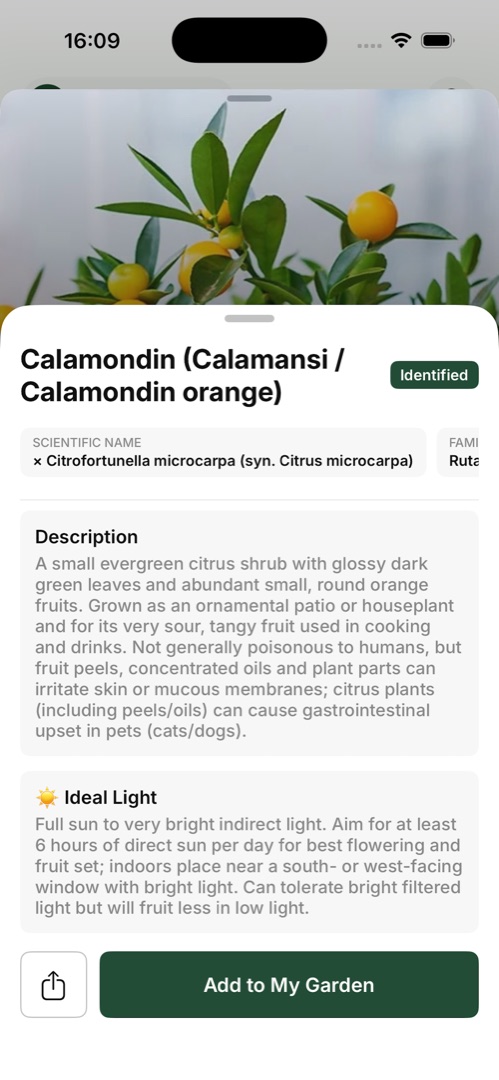
The photos that actually help
- The whole plant, from a normal standing distance. Growth habit — upright, trailing, rosette, climbing — eliminates most of the wrong answers immediately.
- One leaf, filling the frame, including the edge and the tip. Serrated or smooth, pointed or rounded, is a primary character.
- The stem where leaves join it. Alternate or opposite arrangement, sheathing, aerial roots — high-information, almost never photographed.
- Flowers or fruit if there are any. The single strongest clue available. A flowering plant is a much easier problem.
- Daylight, plain background, no flash. Flash flattens texture and shifts colour, and both are features being matched on.
Where confident answers go wrong
| Category | Why it's hard |
|---|---|
| Seedlings and young plants | Juvenile foliage often looks nothing like the mature plant, and many species look alike at that stage |
| Succulents | Enormous genera of near-identical rosettes; even specialists disagree from photos |
| Variegated cultivars | Bred for appearance, so they no longer resemble the species they belong to |
| Ferns | Distinguished by spore structures on the leaf underside, which nobody photographs |
| Anything shot in one dark angle | The model is matching on features your photo doesn't contain |
The one case where "probably" isn't enough
Toxicity. If the question is whether a plant is safe around a cat, dog, or small child, a probable identification is not a safe basis for a decision. Get the scientific name from the identification, confirm it against a reputable toxic-plant database such as the ASPCA's, and if you can't confirm it, keep the plant out of reach. This is the one place where we'd rather you distrust the app.
What to do with the answer
An identification is only the start — what you wanted was care instructions, which is why a good result includes light, soil, temperature and watering guidance for that species and lets you save it so the plant has a history. If the plant looks unwell rather than unfamiliar, identification is the wrong flow entirely: that's diagnosis, which analyses symptoms rather than species. And if the symptom is yellowing, start with the yellow-leaves decision tree.
FAQ
How accurate are plant identification apps?
Reliable for common, distinctive, clearly photographed houseplants; much weaker on seedlings, succulents, and cultivars. A strong hypothesis, not a verdict.
What photo gives the best identification?
Whole plant in daylight, a close-up of one leaf including edge and tip, and the stem where leaves attach. Flowers or fruit if present.
Why did the app get it wrong?
Usually the photo showed the least distinctive part, or the plant genuinely resembles several others at that stage.
Can I trust an ID before giving a plant to a pet?
No. Confirm the species against a reputable toxic-plant list such as the ASPCA's; if you can't confirm it, keep the plant away.